Humans, AI, Hackathon
In early November 2026, Marcus Völkel spends three days in a coworking space in Berlin with a client team and his colleague Bene. A good week later, Timo Wirth wants to know what happened there: with the prototype, with the agents and above all with the people in the room.
- Questions
- Timo Wirth, organisational development at synaigy
- Answers
- Marcus Völkel, consultant at synaigy
- Recorded
- In the synaigy studio in Berlin
- Reading time
- about 20 minutes
Humans, AI, Hackathon
The light in their eyes
What it's aboutHow Marcus recognises a good workshop and why he talks to every single person beforehand.
"I never thought I could work under pressure in such a positive way."
Humans, AI, Hackathon
Timo WirthHow do you know that a workshop with clients is working well?
Marcus VölkelFrom many things. One is what I call energy or vibe: that light in people's eyes. You sense that people are focused and want to contribute. I come from design thinking and design sprints, where the point is to produce as much high-quality output as possible in a very compact time. Seeing how intently people work on something drives me too. It's like a perpetual motion machine.
And then there's the feedback in conversations. Many say things like: "I wish we always worked like this." We go to lunch and dinner together, and I watch the clients reflect on what this does to them. At the end I have them look at their own results: Look around this room, you did all of this today. You can be proud of that.
You've just described it for the others. How does it feel for you?
I'm simply a workshop person. When I notice that it isn't happening, I keep thinking: What can I do now so that it turns out the way I'd like? Improvising has always come naturally to me. And it feeds itself: the more focused people are, the more I want to get out of the workshop. I want them to enjoy the work and to realise: I can be productive here under the highest pressure and still enjoy watching myself produce results.
Do you notice that while it's happening? How was it for you last week?
I notice it very quickly, in the first five minutes.
What exactly told you in this case?
That it gets going straight away. Sometimes clients aren't well prepared, or there's this restlessness at the start: How do we actually begin? Or silence where there shouldn't be any. That's completely normal and nothing bad. But when none of that applies, I know: Wow, this is going to be good.
That has to do with preparation. Something completely new like a hackathon comes with fears. I try to put myself in the individual roles: What is someone afraid of who is thrown into a new role and a format that lasts three days? How do I need to support that person beforehand so they know what's coming and how they can help make it a success and fun? I talk to everyone beforehand, sometimes in a group, sometimes one to one. Then I know: Nobody will ask how this works. Or, which can be bad: Why are we actually doing this?
The interview
One team, one prototype, three days
What it's aboutWho sat in the room, what they worked on and what should be in place at the end of the three days.
Humans, AI, Hackathon
Timo WirthBriefly on the setting: you spent two and a half days off-site with the client. How many of you were there, and who was there?
Marcus VölkelThere were six of us: Bene and me and four from the client. They come from the digital department of a group of companies. The department is responsible for digitalising the products and for innovation; its job is to develop digital services and products.
There was the director of the department, whom I've known for six years and work with directly very often. The team lead for digital services, our interface to engineering and to the technology service providers. A project manager who comes from business development. And, relatively new to the team, a business developer who works on things like operationalisation, financing and revenue models.
I've been working closely with this core team for about three months. They invest a lot of time and attention in the project and always show up as a group of four. That helps create depth and make decisions quickly.
What was the occasion?
We're developing a new platform, a dashboard. It's basically the client's existing app, only bigger. The app is for end customers who use one of the client's products. The dashboard is for people or organisations that have lots of them.
What was supposed to come out of the three days?
A testable prototype that is checked in the user and UX test just under a week and a half later. A backlog for the rest of the year. And a milestone plan for Q1. By the end of Q1 we want to have a digital product that one, two or three pilot customers can test.
What helped you get there?
Trust, first and foremost. That trust in each other, that we can sit together in a very small space for three days to take forward the prototype I had developed up to then. And then we had Bene. Together with me he developed a process that lets us make decisions quickly and work changes into the prototype quickly.
After two and a half days we had a prototype that had moved on a great deal and is very close to our vision. After the user test we have just under two and a half weeks to iterate on it with the feedback. Then we take the prototype into implementation.
The interview
One room, rules and a Goldendoodle
What it's aboutWhy a single room was the right decision, which rules apply in it and what a dog adds to the mood.
Humans, AI, Hackathon
Timo WirthWhat role did the room play? Six people in one room, for three days.
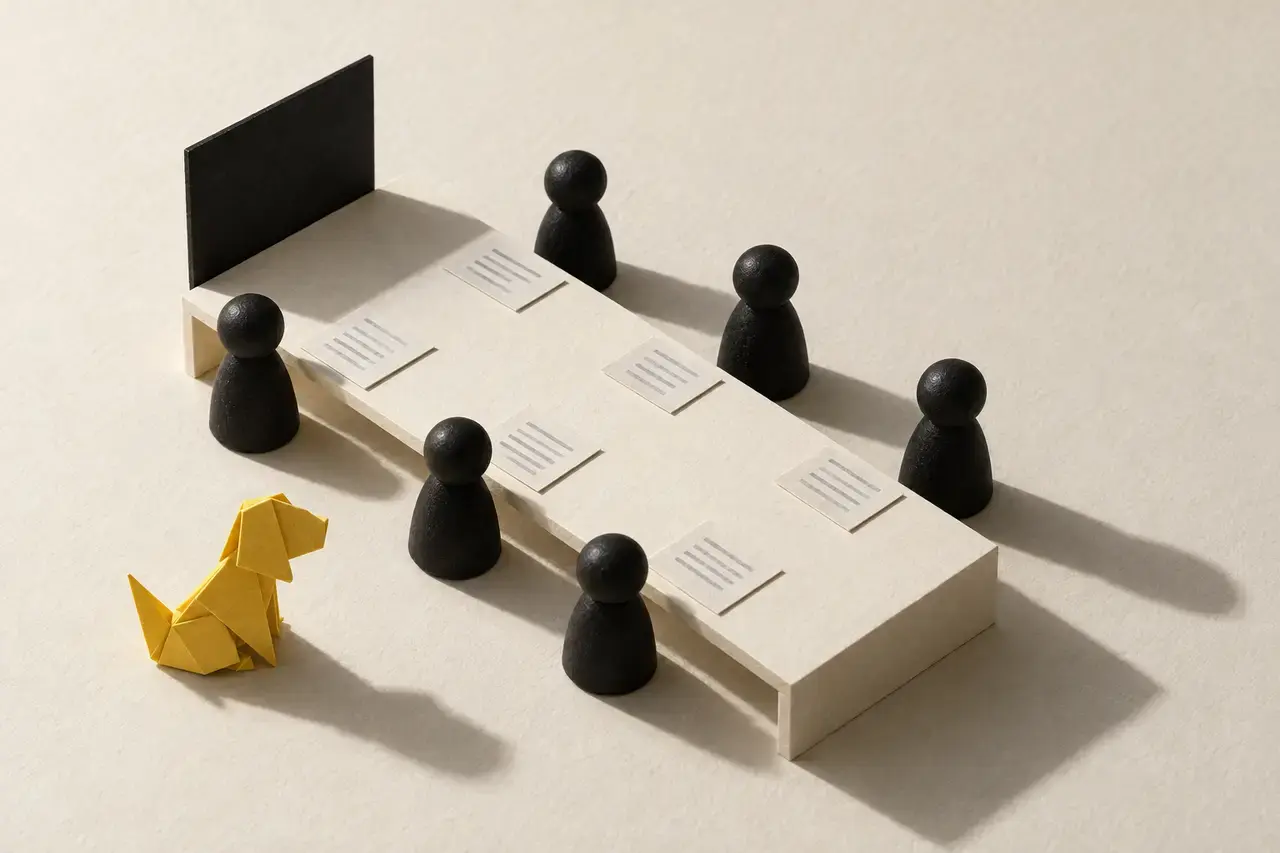
Marcus VölkelThere were a lot of uncertainties, because we hadn't done this in this form before. I was very unsure whether one room was the right choice and had considered doing it here at the agency in two or three rooms. The four of them aren't necessarily people who can judge which features have to go into the prototype. A project manager looks at quite different things. Whether a button is red or blue matters less to her. She wants the project to work.
In the end it was fantastic that we were in one room. It gave us a frame. You can do something like this remotely too; we didn't put up posters anywhere, everything ran on the computers and on the big TV. But the room was important for keeping the energy up and working on the goal with focus.
The usual argument is: Dear client, come to us, then you're out of your everyday work and nobody distracts you. In this case that applied to Bene and me as well. We were out of our everyday work too, and that helped enormously.
How did you manage to keep the energy in the room? It has almost become normal to deal with a few emails on the side during an important meeting.
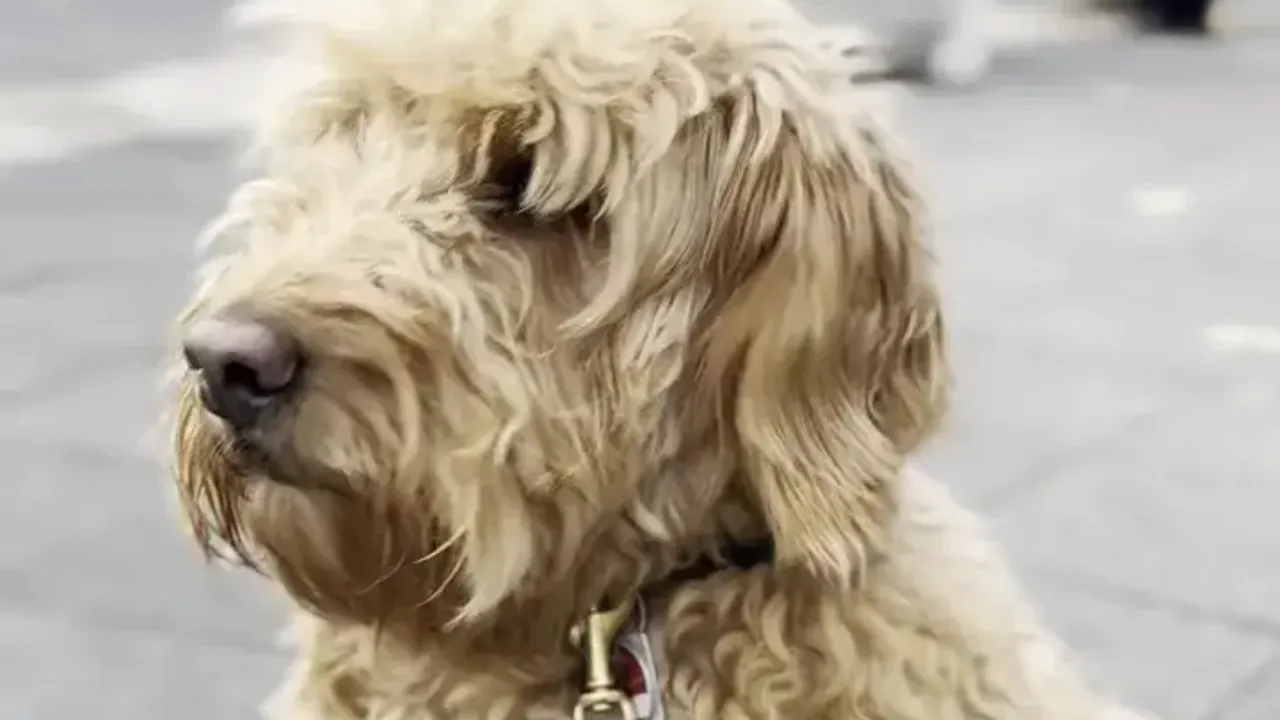
There are rules, and the clients commit to them: no meetings, no calls, no emails. More breaks instead. That's what the breaks are for, and I take a lot of breaks. And my secret weapon is a Goldendoodle.
What's that?
Honey, my dog. She was there every day, and that's a factor you shouldn't underestimate. She sits down and asks for a bit of petting, and people are just in a good mood. When we said goodbye after the three days, the whole team of the coworking space came to the exit to say goodbye to Honey.
Isn't that almost paradoxical? You worked heavily with AI, and at the same time it sounds to me almost like a digital detox.
In design sprints it's even more extreme. We use AI intensively there, but for the first day and a half one rule applies: no laptops, no phones, no AI, only Post-its, pens and your own brain. We let the AI run the whole time. It records our conversations, but also everything that happens on the walls, all the Post-its, all the scribbles, all the interviews. Only afterwards do we use AI for sparring and for taking our own ideas further. And that is disruptive.

The interview
Deciding while it takes shape
What it's aboutHow a sentence spoken in the room becomes a visible change within minutes, and why the team mostly talked to each other along the way.
18tickets in one hour
Humans, AI, Hackathon
Timo WirthIn the hackathon you took the tech away from the four participants, right?
Marcus VölkelExactly. Bene and I had the tech. The prototype ran on the big TV, and Bene developed a tool that sits on top of the prototype. You activate it, use the mouse to select an element, a module or the whole page, type a prompt or feedback and press Enter. Then it lands in GitHub.
I went through the prototype with the client, user flow by user flow, and entered the feedback. It was saved as an issue, with the acceptance criteria that came out of the conversation with the client. Bene's agent team pulled the issues and developed them. Each finished issue got its own URL on our dev server, so we could show the change. And at exactly that moment we decided: keep, iterate, throw away.
That was brilliant. The group was perfectly put together for it, because everyone could give input from their own role. At the peak we had, I think, 18 tickets an hour. It felt incredibly easy.
Normally you gather requirements, write a backlog with acceptance criteria, someone picks up the ticket, then the work gets done, and you wait until the next meeting, review or weekly. The feedback goes back into a ticket. All that slowness and heaviness, which was actually completely normal and which nobody questioned, now seems antiquated.
Right now people are trying to speed up exactly this process even further. Everyone feeds things into some AI on their own, produces even more data and sends even more information back into the loop.
That's a big problem: data is no longer curated and no longer assessed. There's no judge in between who says these are the important data now. In the hackathon that was Bene. In the end Bene was Master of the Merge.
People want to speed things up with AI and actually make them more complicated. You almost used a kind of slowing down to bring the human factor plus AI into one room.
That's exactly the principle: using AI not for its own sake, but as extended intelligence, augmented intelligence, to amplify what is already in us. You have your strengths, I have mine. We don't let anyone take them away from us. The point is that we can bring them in with focus, and AI can help us with that if we do it right.
If I understand you correctly, you simply allowed more humanity. At the core, you talked. Usually people say afterwards: We talked a lot, but now the real work begins.
I wasn't consciously aware of that. But now that you say it: that's exactly it. We talked an enormous amount, and it was important that everyone could bring in their perspective. Once it was clear what we were deciding on, things moved very fast. For that, as the facilitator, I had to keep saying: We need a decision now. And, as in a design sprint, we had chosen a Decider in advance.
The interview
An experiment becomes a project
What it's aboutHow a preliminary project that Marcus did on his own became a priority, and what the client said when he proposed a hackathon.
Humans, AI, Hackathon
Timo WirthIn hindsight it looks easy. For it to become easy, I think it takes a lot of courage beforehand: Can we expect this of the clients? Can we even steer this setting? Where are you glad you were brave?
Marcus VölkelI'm driven by curiosity and I come from innovation. There it's always about breaking out of something familiar, trying something new and deliberately making room for failure. So I don't feel brave.
Maybe it took courage at the point where I said: I can do this entire initiation phase, the whole preliminary project, on my own. That was an experiment and relatively low-risk, because at the beginning the project didn't carry much weight yet. It came out of a design sprint. What can one person actually do alone if they have a very high AI budget? I agreed the budget with the client. On top of that, I've known the client for a very long time. He trusts me and asked me: Help us become AI-native and able to work AI-first.
Then there was a big meeting with sales and the management. The director presented the prototype, and everyone said: We have to have this. Suddenly the project got a priority that made me think: Now I have to be especially brave. It soon became clear that we would expand the project and develop the prototype further by the end of the year, as the basis for implementation from January.
There are a lot of risks in that. That's why I suggested: Let's do a hackathon together in November. And I thought it wouldn't be a bad idea to have someone like Bene there, who has much more experience and expertise with code than I do.
What did the client say to your proposal? You already have a big AI budget, and then you say: Next, six people meet in Berlin for three days. Wouldn't the obvious answer have been: You're crazy, here, just have more tokens?
No, the answer was: How awesome is that? We've never done that before. The department really wants to be ahead. They've hired someone responsible for AI, they work with ChatGPT Enterprise and with Claude and use Claude Code. For them these are two prestige projects: the dashboard and making the department AI-native. The director shows me skills and prototypes he has developed himself, for example a chat application that lets him talk to his Power BI data.
Along the way I provided an MCP that everyone has in their Claude or ChatGPT. It gives them access to all transcripts, all workshops, all interviews, the entire hackathon and the prototype. The client has exactly the same data as we do, and this transparency does the quality a lot of good. Everyone comes to meetings prepared, and it's clear what needs to be done.
And the most remarkable thing: nobody has ever missed a meeting. Even though it would be fine if only one person came. Everything is recorded, after all, and on Friday afternoon there's a summary of the week. Still, everyone is always there. I find that really lovely.
Despite that, or because of it? Can the right use of AI help people come together better as people?
I can't really tell you why it works so well. What I like about these clients: everyone is really keen on the project. Everyone gives it their all, and they all bring curiosity and courage: Let's do this really well. If we're unlucky, it'll hit the wall. But nobody is really afraid of that.
The interview
The second day
What it's aboutOn one day, eight people sat in the room instead of six. It brought many results, took a lot of energy and led to Marcus' most important lesson for next time.
Humans, AI, Hackathon
Timo WirthDid you ever hit a wall during those three days?
Marcus VölkelYes, on the second day. Even six people seemed too many to me. Originally I wanted to do it with just four, to be as productive as possible. Then two from the core team joined so they could get to know the method. I was afraid we'd get more input than we could process.
Beforehand I had run three stakeholder workshops with thirty participants in total. Two of them came from sales and were very critical, in a constructive way. I wanted to keep working with the two of them, and the director had the idea: Let's take them along to the hackathon. I didn't like that at all, but then let myself be persuaded. So on the second day there were suddenly eight of us.
In a room like that you do several things at once: you have the setting, the dynamics and the schedule in your head. What was going through your mind that day?
Picture the room: relatively small, maybe half the size of this studio. A long table in the middle, a big TV on the wall. Bene and I sat opposite each other right by the TV, the clients around us, and in between the mic and lots of snacks. With eight people that was simply too much in terms of energy.
On top of that, the two of them had a completely different customer group in mind from our project. For the dashboard we're talking about anything from a small business with two or three locations to a bakery chain with twenty branches. They're talking about sites on a completely different scale. A lot of input came in, and about every thirty minutes I had to step in: Look, we're in this flow right now, on this screen, and the point is to make a decision now.
I don't like doing that: becoming dominant, taking control. I actually have methods for that. But then you need that clarity. In the end the day was a huge success; on that day alone we processed and closed, I think, sixty GitHub issues. But it was incredibly exhausting. Afterwards I was completely wiped out.
And the positive voices in your head?
This one: Wow, my concept works. How everyone works together, how much good humour there is. Then I notice it's flying right now, I hardly need to steer. I only have to steer when people can't agree. Then I say: We have a Decider, what does the Decider say? Then there was a decision, and nobody questioned it. It's so easy. But to reach that ease, a great deal had to happen beforehand.
I've done design sprints very often. I know exactly what works and what I can insist on. With this format I allowed much more, even though I didn't want to. What I would do the same way again: being away from the office. We held the last three workshops all in this coworking space. The food is sensational, the team is warm, and everyone in the whole building works on innovative things. You can feel that.
The interview
What AI does to people
What it's aboutAbout warmth in the room, about a team in which nobody interrupts any more, and about the question of what would be left of the project without AI.
Humans, AI, Hackathon
Timo WirthEarlier you mentioned Honey, almost in passing. Little things like that can make a difference. What did she set off?
Marcus VölkelHoney really is a factor. She has a very winning nature, and a great many people react incredibly positively to her. The coworking space has its own restaurant, and everyone there greeted her. That relaxes the clients. They start telling you about their own animals, and the warmth that creates shouldn't be underestimated. Then it's no longer just about business. You have something you share. That's how moments come about in which clients say at the end: I could simply be who I am here and didn't have to play a role.
How did that show?
In that relaxed ease, and in the respect for one another. What's brilliant about this group is how everyone has got used to working with the MCP and with AI. Nobody interrupts anyone, because everyone knows: if someone interrupts, it messes up the transcript. The appreciation for the other team members is enormous.
That almost sounds as if AI helps the people in your room treat each other better and more mindfully.
That's a question of perspective. If we asked Bene, the answer would be completely different. For him it was much more about orchestrating his agents so that they don't get in each other's way. At times he didn't even notice that much, he was focused. But I know he enjoyed it enormously.
For me, having known the client for many years, it's clear to see how AI empowers them. The project manager, for example, is much more active today because she has a much better overview and can contribute more on substance. That's good for the project: the different perspectives and the trust that the data is good.
Of course there's the distance: that's a client, we're the service provider. But it doesn't feel that way. It really feels like this: We're a team. We have the same goal.
If we take the AI out of it again: would you be a better or a worse team?
I can't judge that. The collaboration has rather become different. It's satisfying because you can see so much so quickly, and I think the handover to implementation will be easier. Without AI we would have had the workshops and interviews and probably a Figma prototype for the UX test, with all the limits a Figma prototype has, and with a concept that hasn't yet been checked against technical feasibility. There would have been many more risks in that. And we would have needed more people: me as consultant, project management, design, concept, maybe technical consulting as well. That's five people already.
It sounds as if working with AI brought you closer together as a team. And yet no AI said: Move closer together, meet in a coworking space.
That's true. But it's also the whole methodology. Even a dinner is part of the method. We're together in a small space for a very long time, without distractions, from breakfast at half past seven until midnight. That does something to you. Even without AI that was intense and led to stronger client relationships.
But AI simply is an amplifier. If we use it well, and I think we do in this project, it amplifies our strengths. We can be more focused, work with more concentration and contribute much more. The limits set for us are different ones. We can make more possible and be more innovative.
The interview
Hackathons instead of sprints
What it's aboutHow the exception could become everyday work, what stands in the way and why Marcus doesn't feel that AI takes anything away from him.
A sprint: two or three weeks
A hackathon: three days
Humans, AI, Hackathon
Timo WirthThat was very far from everyday work for everyone. How can something so out of the ordinary become ordinary?
Marcus VölkelThat's on my mind too. We asked ourselves exactly this question: What do we want to take away from this? Why did we enjoy it so much, and why can't we get it into our everyday work? What if there were no more sprints, only hackathons? Three days on site with the client, making decisions right away, celebrating together in the evening and celebrating ourselves.
Why is that so hard?
For example: no resources on the client side, no time, no attention. But it's a vision where I think: That's where we need to get to. Working with well-tuned agents and being able to make decisions at the same pace is so helpful. For the result and for satisfaction.
It would be good if we weren't the only ones working like this. You can simply take one sprint and say: We'll run this sprint as a hackathon. Instead of working for two or three weeks, we see what happens when we sit together for three days. With good skills, good workflows, with agents working within strict guardrails, with a clear process and good facilitation.
If we add it up: you were faster, and there were fewer people. So overall it was faster, cheaper, more enjoyable and came with the feeling of being more effective.
Right. And we have a project that we wouldn't have got in the past, or wouldn't have done at all.
Usually the story is told the other way round: AI takes this and that away from me, AI speeds things up, and I have to deliver. You turned that around.
That's a question of perspective and framing. I've never felt that AI takes anything away from me. But I do constantly feel that I have to question my own role and my impact in a world like this. Where is my personal moat? I don't like the word, but: Where am I good, where are my strengths? I do see that AI is better in many areas than what I've delivered so far. But it also helps me develop and become stronger in what makes me unique.
Does that mean, conversely, that you don't let AI in where your moat is?
On the contrary, I let AI in there very deliberately, to amplify myself. For example with my behaviour mirror. That's a skill that analyses my behaviour and my statements in every transcript: how I came across and what I can do better. Sometimes there's utter bullshit in it, but it helps me reflect on myself.
When I think back from the start of the year to now, AI has made me much more effective in almost every area where I was always good. Nowhere do I feel that it replaces me or puts me under pressure. But I had to learn to deal with this productivity. That was a hard process that took months.
The interview
Quickly visible, checked together
What it's aboutWhere AI made the team in the room more effective, what groundwork lies behind it and how the team deals with agents getting more done than can be checked right away.
Humans, AI, Hackathon
Timo WirthBack to the coworking space once more: where did AI make you more effective as a team?
Marcus VölkelThere was this moment, and it came very quickly: everyone realised I can now clearly ask for things. Features, changes, iterations. Because they become visible so quickly.
You mean that in the past people would have said: That's too much effort now, it's too late. Or they wouldn't say it at all.
Exactly. People don't say it at all, or they don't feel understood. There are lots of misunderstandings, after all. Now someone sees the change and can say clearly: No, that's not what I meant at all. That has an effect on the whole group.
And how quickly Bene was up to speed. I onboarded him a week before, with a few small sessions. He didn't just implement, he brought in ideas of his own. Everyone was thrilled with him. Totally relaxed, he sits in front of his Mac, gets on with it, and then says: Shall I show you something?
In our conversation you've talked more often about people than about AI features, the prototype or modules.
I find it much more exciting what AI does to people. The word dynamics captures it quite well: the dynamics that arise when AI is used well. Amplifying what makes us human.
Many people are currently describing that with AI you have to work more like a machine and specify more. You seem to me to be a step further already.
You raised the problem that too much data is being produced and no longer the right data. Methods like these help keep that in check. And I think much more about what things need to be like for the AI so that it can work as well as possible. That's why I started with a Storybook and arc42 documentation, even though it's a prototype. I had in mind: What if it gets big? How do I have to hand it over so that agents can implement it as well as possible? Seeing how Bene simply cloned it and could work with it was really cool.
During those days, did you feel like machine operators?
Me, never. You'd have to ask Bene. The clients feel empowered, and that influences the collaboration. Everyone is better informed, deeper into it and very good at sparring. On top of that come the clarity to see risks and the openness to be critical.
And the understanding for each other: You've just had your agents complete 120 to-dos, of course you can't check everything. Then it's fine for us if we only tick off 60 this week and the other 60 at the end of next week. The main thing is that we've all looked at it. That's the downside too: so much gets done. You have to say where you trust the results, where everyone has to look and where one person is enough.
It's a process. At the start of the year AI wasn't that good yet. When summarising a one-hour transcript, it hallucinated. That's why we didn't just throw everything into ChatGPT or Claude, but have a knowledge graph where everything lives. Today we agree that the AI hardly hallucinates any more.
The interview
Three stickers to finish
What it's aboutWhat Marcus takes into the next week and which sentences remain from the two and a half days.
"Post-its have been part of my life for 20 years, but I've never experienced Post-its as disruptive. Now they are."
Humans, AI, Hackathon
Timo WirthWhat are you taking from the hackathon into next week?
Marcus VölkelFirst, of course I'd like to work like this all the time. Second, you need clients with whom it works and who can take the time. The picture would be: a hackathon every two weeks, and in each third week a remotely facilitated UX test. And on our side you need people who can work like this. I myself now work much more with Post-its and pen again and use AI much more purposefully than before.
If you could make two stickers with a slogan that captures these two and a half days: what would they say?
We used AI in a very advanced way everywhere: from our own knowledge graph and databases we fed in real time to the MCP and the whole workflow in GitHub. At the same time we say: Before we use any of that, we work with our own brain, with pen and paper. We only use AI once we've thought all of that through, to amplify ourselves. As a sparring partner it extends our own intelligence.
And what of that fits on the sticker?
I'm not good at copywriting. But: Post-its have been part of my life for 20 years, and I've never experienced them as disruptive. Now they are.
Do you have a second one?
Something that shows the fun. What I find really impressive: that together with the clients we closed almost 90 tickets in two days. And with a pressure that we all experienced as positive and that was so much fun.
And what's still unusual right now, at least in the bubble around me, is this transparency towards the client. We equip our clients with the MCP, give them access to everything and teach them how to work efficiently with AI, so that they can work better with us.
What do you mean by hyperpowered?
Not just being enabled to do something, but developing new abilities along the way. Everyone at the client said this, interestingly independently of each other: It surprises me how much I've developed myself. That's something we haven't heard like that before.
The interview
The stickers
In the conversation, three slogans emerge from Marcus' answers.
Fun is the best pressure.
Full transparency, total enablement.
From enabled to hyperpowered.
MAIA, the AI chat on hyperpowered, answers questions about the AI hackathon.